
Externalities
Goodhart's law & Pigouvian taxes

You’ll see it everywhere.
I used to work at a call center for Progressive Insurance. They were weird at the time because they didn’t measure something called “handle time.” Essentially, most call centers based your performance on how short you could make each call. Realizing the company saves millions whenever there are seconds shaved off calls, many companies made it their North Star.
Progressive was different. They said, “Take the time you need to solve the problem, and look for upcoming problems to proactively solve.” Is their new policy coming up and they don’t have autopay? Set that up! Keep them from accidentally canceling or calling back to make the payment.
Why did they do this? Because when you shortened calls, you incentivized shorter call times, which often meant people ended up calling back. Individual call times were down, but total call minutes went up across the company. Progressive realized proactive problem solving was a better northstar than a simple metric.
In this case, when you take a metric and make it a target, it ceases to be a helpful metric.
Or, officially, Goodhart’s Law states: “When a measure becomes a target, it ceases to be a good measure.”
This hurts us in economics because when interest rates, the NYSE, or something else becomes the measure of the economy—and then the target—the market begins to manipulate itself to hit that number. At that point, the measure becomes less useful. After all, who cares if stocks are up if I have no money to invest in those stocks?
Goodharts law pervades all elements of society.
Externalities.
Keep Goodhart’s Law in mind, and let’s move on to another economic term: externalities.
Arthur Cecil Pigou wrote a book called The Economics of Welfare. In it, he popularized the concept of externalities. Think of externalities as private decisions that positively or negatively affect members of society.
Here’s a SUPER simple example:
Positive externality: You plant a tree that shades the road, provides a place for a swing in the future, and benefits people in the future and in the public realm who had no part in the decision to plant or maintain that tree.
Negative externality: You cut down a tree on your yard that you had every right to cut down, but as a result, people lose shade, the nearby temperature is affected, etc.
Now, a single tree is quite the oversimplification. Externalities can often be life or death. Think of a super-profitable chemical company that increases the lead content in the soil to toxic levels. Decades after the company went out of business, the EPA is still cleaning up lead from the soil, and people continue to get poisoned. There’s a world where this company does the right thing from the beginning and there is no contamination, but they couldn’t do so without cutting into their profits.
But their profits were paid for by society, which had no choice in the matter.
Modern externalities often have good intentions.
Our cities are generally more careful about the types of obvious negative externalities they allow into their region. The fight against data centers is an example of this. But every policy either creates positive or negative externalities.
A new park may increase home values, bring neighbors together, and include a stormwater feature that makes the area more flood-resistant.
But often, even programs with negative externalities have positive intentions. Let’s say your city decides to help subsidize a stadium. They create a special tax district to finance it. While taxes can still go to schools, police, and roads, the rest of the tax revenue in that district goes toward the stadium until it’s paid off.
The idea is that the value the stadium brings increases tax revenue overall, and the investment compounds. But that doesn’t seem to be what happens. Often, the expenses are underestimated, and they take decades to pay off. In fact, according to Brookings research, the spending that stadiums bring in often isn’t net new spending, but shifted cultural and entertainment spending. Meaning, yes, more people go to see the baseball game, but fewer people are going to other forms of entertainment.
The negative Externalities of suburbs
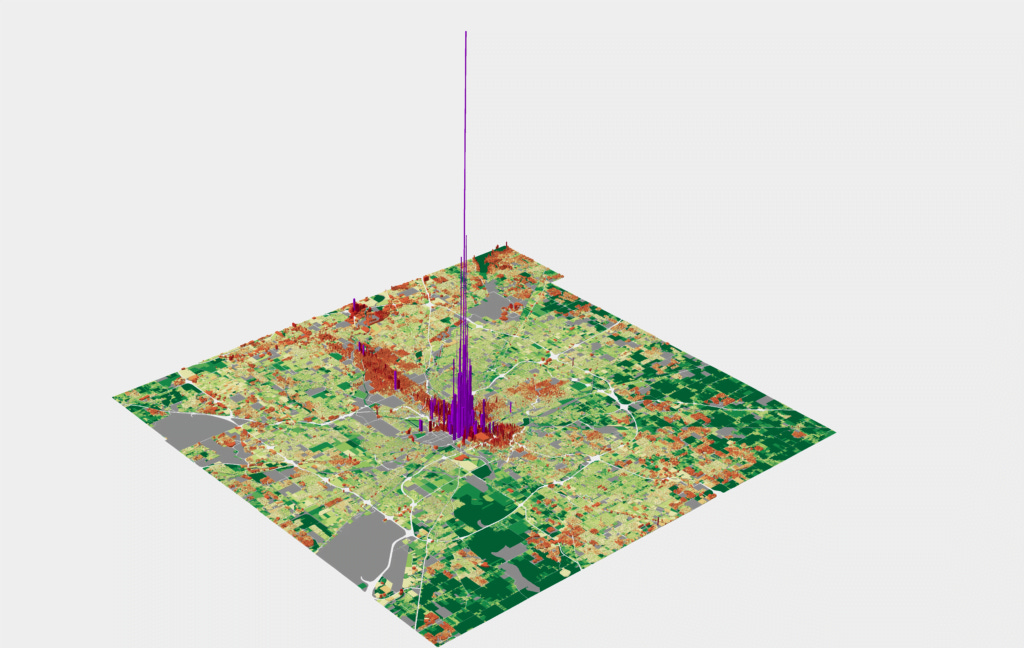
Now let’s talk about modern suburban development. In rural communities, there are often low tax, low public service areas. You might live on a gravel road, and have a septic tank, and not pay high taxes. Within a city, you have high service, but also high tax producing areas. Notice I say tax producing. The taxes don’t always have to be extraordinary high within cities, but they generate more tax per-acre. But the suburbs are low tax producing high service areas.
Which means they cost a lot without producing anything.
Lane miles:
Chattanooga has a population of 180,000. Jersey City has 250,000. Chattanooga must maintain approximately 2,500 lane miles of roads, while Jersey City maintains about 250. A city with a smaller population has 10 times the roads to maintain.
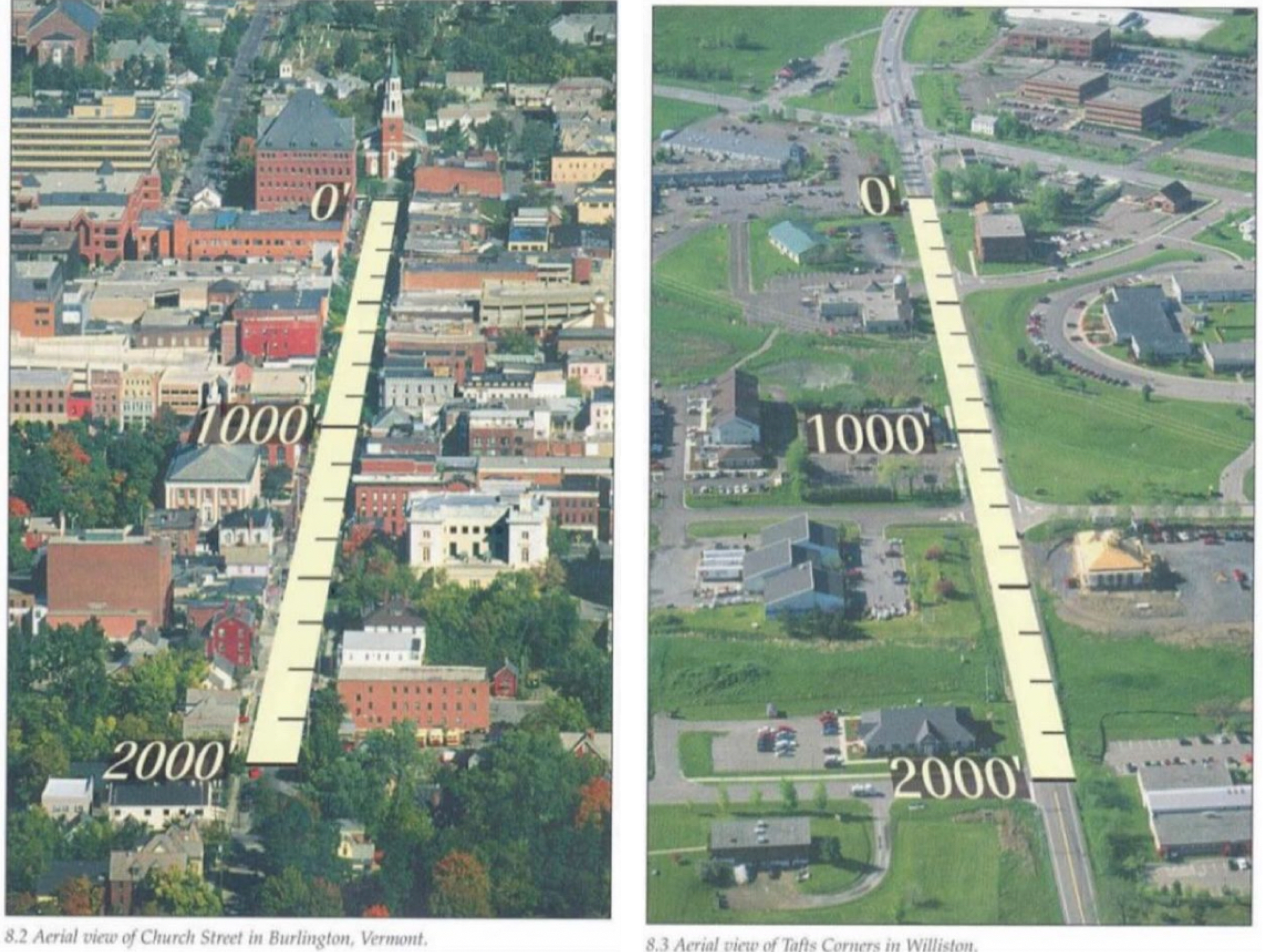
Think of it like this: 2,000 feet of asphalt on a 35-foot-wide road costs the same to build and maintain in a neighborhood as it does downtown. But downtown can not only afford to build and maintain it with the tax revenue it produces, it also subsidizes many other miles of roads throughout the city.
Parking:
Most American cities require parking for new construction. This is a convenience for someone arriving by car. But it is paid for by the business itself, and thus the burden is transferred into the price of the product or service, regardless of how the customer arrived. What’s more, it heats up the area, increases water runoff, places a much larger burden on the sewer system, and is more apt to cause flooding.
Marketing:
Businesses thrive by clustering together and being close to their customers. But to create the suburban city, we’ve separated uses: businesses are far from neighborhoods and, thanks to parking requirements, far from one another. Yet the most valuable parts of many cities are often the pre-zoning neighborhoods where businesses could cluster without parking mandates. Someone who comes to buy a suit is more likely to grab a latte next door.
When every outing requires an intentional trip, small businesses have to constantly fight for attention. Marketing becomes far less important when people are already walking past your front door. Most stores in the typical mall don’t pay for marketing.
Big Empty buildings:
When a small store is vacated, it’s reasonable to transform it into a different business. When a barbershop closes, it can become a coffee shop, restaurant, dry cleaners, or any number of other reasonable small businesses. But when a superstore or factory closes, it may sit vacant indefinitely. I can think of three superstores in my area that have essentially moved across the street and left a hulking shell of a building sitting vacant for years.
They create a cycle
Now look at the four things above and see how they affect each other. The big empty building sits along a road it should be paying for, has a huge parking lot, and is pushing businesses farther apart.
Many of our problems are an entanglement of Goodhart’s Law and negative externalities. We become fixed on addressing a measurement, try and fix it, and obsessing on that number, we make things worse.
We build suburbs to address housing, traffic gets bad. Commute time as a measurement becomes a target. We build wider roads to accommodate that. But suburbs just continue to spread further out, and traffic gets worse.
Roads and sprawl create un-walkable areas, so more people require the use of cars. The few places where you can live car-free become unattainable to most people financially, so they move further out.
Cities begin to annex these outlying areas to capture tax revenue. But with that comes a maintenance price tag on the infrastructure that isn’t equal to the taxes generated.
Our cities in America are enormous because of this. Utrecht, in the Netherlands, is 38 square miles and has a population of 370,000+. Chattanooga has half the population, yet is 151 square miles. There is a social cost borne by those in the higher tax-producing parts of a city.
Solution:
I’m not sure there’s a neat answer to this. In fact, I’d be suspicious of one. Any singular focus on a meaningful metric has the potential to backfire (Goodhart’s Law).
If you think in terms of carrots and sticks, we already have examples of both. On the stick side, there are Pigouvian taxes, which charge for activities that impose costs on society, like New York City’s congestion pricing. On the carrot side, some cities fast-track preapproved housing plans through the permitting process, making it easier to build the kinds of housing they want more of.
But the hard truth is that we didn’t get here because of one bad decision. We got here through hundreds of small decisions, made over decades, that slowly tangled the system. And if that’s true, we probably won’t untangle it with one grand solution either. It’ll take hundreds of small improvements, made consistently over time, each one nudging the system back in the right direction.
I had never heard of Goodhart's Law! SO GOOD!
And that Indy graphic is wild