
Proximate placemaking
Activating space for the people who actually want to use it

There are few words in city planning that make my skin crawl quite like “anchor” and “activation.”
The word anchor is often used to justify spending big public dollars on massive developments.
We’re told that a stadium, a convention center, or a shiny new project will be a cultural anchor—something that draws people in and brings a neighborhood to life.
But this kind of anchor usually means one big thing dropped in the middle, with the hope that its presence alone will magically create vibrancy, small businesses, and street life around it.
It rarely works that way.
And then there’s activation, which always sounds a little too much like a spell someone forgot the words to. A big, expensive plaza is built, and when no one shows up, the solution is activation. Just get people to notice it, they say. Just program it. Just add yoga.
It’s like putting jumper cables on a car with both a dead battery and no alternator: if it requires constant support like this, something else needs to be addressed.
This week, we’re talking about a better way to think about activation (perhaps anchoring in another issue). One that starts not with a blank slate, but with the people who are already here. Less “if you build it, they will come,” and more “what would happen if we built something for the people already kind of hanging around?”
Because sometimes the spark isn't something you drop in from above. It’s something you grow from the ground up.
Two videos about Copenhagen sparked this week’s issue. But here’s the thing: I’m going to include as many American examples as possible, because nothing gets dismissed faster than a “rich Nordic country” doing something good.
Still, it’s worth showing what Copenhagen is doing—not because it’s perfect, but because it proves what’s possible when you actually commit to ideas like this.
Proximate placemaking
Placemaking is becoming a bit of a buzzword. It’s used to describe more or less making places functional or interesting before there’s things there to actually function or people to be interested. Don’t get me wrong, adding benches, flower boxes, or painting murals does bring value. But often it looks good for a photo op, then doesn’t really get used or appreciated. And when the paint fades and the flowers wilt, it’s usually the locals who are left to clean up a mess.
Proximate placemaking may be a word I made up, as I can’t find a substantial use of it, but I want to use it as way to describe a sort of transitional placemaking; one that first embraces who is actually there, and then aims to create a place for the future users. An example (and one I’ll be using for this discussion) is skateboarders; a sort of pioneer species that has returned to a place otherwise devoid of life. And then focusing on future end users, like children.
Skating—designing for the current user
I often find biology to be the best lens for understanding cities, because cities behave more like ecosystems than machines. When an ecosystem experiences a major event that might destroy life in an area, the first species to return is called a pioneer species. This period of returning to life is called a second succession, and the pioneer species’ presence makes the place a little more habitable. As a result, other forms of life return.
Secondary succession is the natural process by which ecosystems recover and regrow after a disturbance (like fire, flood, or farming) that leaves the soil intact. It’s how life returns to an area that once had it.
I see skateboarders as a pioneer species. They go to liminal, if not deserted, places and bring life back to them. The goal of a public space is to be used; a place for people to interact, build relationships, do business, and experience rest. Yet, whenever a skateboarder is seen in public, they're treated as a problem to be removed; a weed to be eradicated.
Yet it is this very hardiness of “weeds” that we need as pioneers. We want things that grow through the cracks of harsh environments, because that’s where we need growth the most. There’s an ongoing meme about how an outdoor plant can thrive under any conditions, while our houseplants are somehow allergic to tap water. This is a feature of pioneer species, they go where others won’t.
We have this obsession with creating designated places for different activities within our cities, as if we are deathly afraid that people from different areas of society might interact.
Giant fields and sports complexes are built to satisfy a region and obliterate any notion of a neighborhood league or park.
Our goal too often seems to be building one giant megaplex, combining churches, stores, and, of course, a skatepark. We create isolated zones, small ghettos designed to keep anyone from encountering the perceived joy or differences in other people's lives. We become obsessed with taking what we label as problems and relocating them to confined areas, out of sight and out of mind.
Yet we still long for lively places: streets with shops and cafes, full of people and buzzing with energy. To make that happen, we need people in those spaces. And to get people there, we have to give them a reason to go.
This is where proximal placemaking can take root. I saw a video about how Copenhagen approached this challenge by integrating skateable features directly into the design of public spaces. It wasn’t about building separate zones. It was about weaving activity into the everyday fabric of the city.
But we are not Copenhagen. We don’t have their politics, or their density, or their habit of biking through snow with two kids and a cello strapped to the back of the bike. So how would something like this look here?
In Lafayette, Louisiana, there was a park that emptied out after COVID. The only people still using it were those without homes. A widely-believed theory emerged: that their presence made parents nervous enough to stop bringing their kids. And when the parents stopped coming, so did everyone else.
A downtown development group was asked to bring the park back to life. They could have focused on removing the homeless population. But instead, they asked a different question. Maybe the issue wasn’t who was there, but who wasn’t. Maybe the problem was not danger, but absence. If a park is like an ecosystem and this one had gone dormant, maybe it needed a pioneer species. Something that comes first and makes the space livable for everything else.
They remembered that skaters used to hang out there. So they designed new benches. Not benches that looked like skate features, just benches. But they quietly worked with a local skate shop to make sure they were fully skateable.
It was subtle. It was quiet. And it worked.
The skaters came back. And slowly, so did everyone else.
Because maybe the key to reviving public space is not removing people, but inviting more people in. The right people, at the right moment. People who bring movement and energy.
In Providence, Rhode Island, I stumbled onto something quiet and remarkable. Trinity Skatepark is wedged between a parking garage and the back doors of an ordinary building. It sits on Adrian Hall Way, a street that feels more like a service alley than a place you’d ever choose to go. And yet, skaters go there. They always have.
For a long time, it was just an open patch of concrete. A park that barely functioned as a park, except to the people who saw its potential. Eventually, through years of advocacy—and none of it guaranteed—skateable features were added. Not because someone in power suddenly understood skate culture, but because people asked again and again, until someone finally listened.
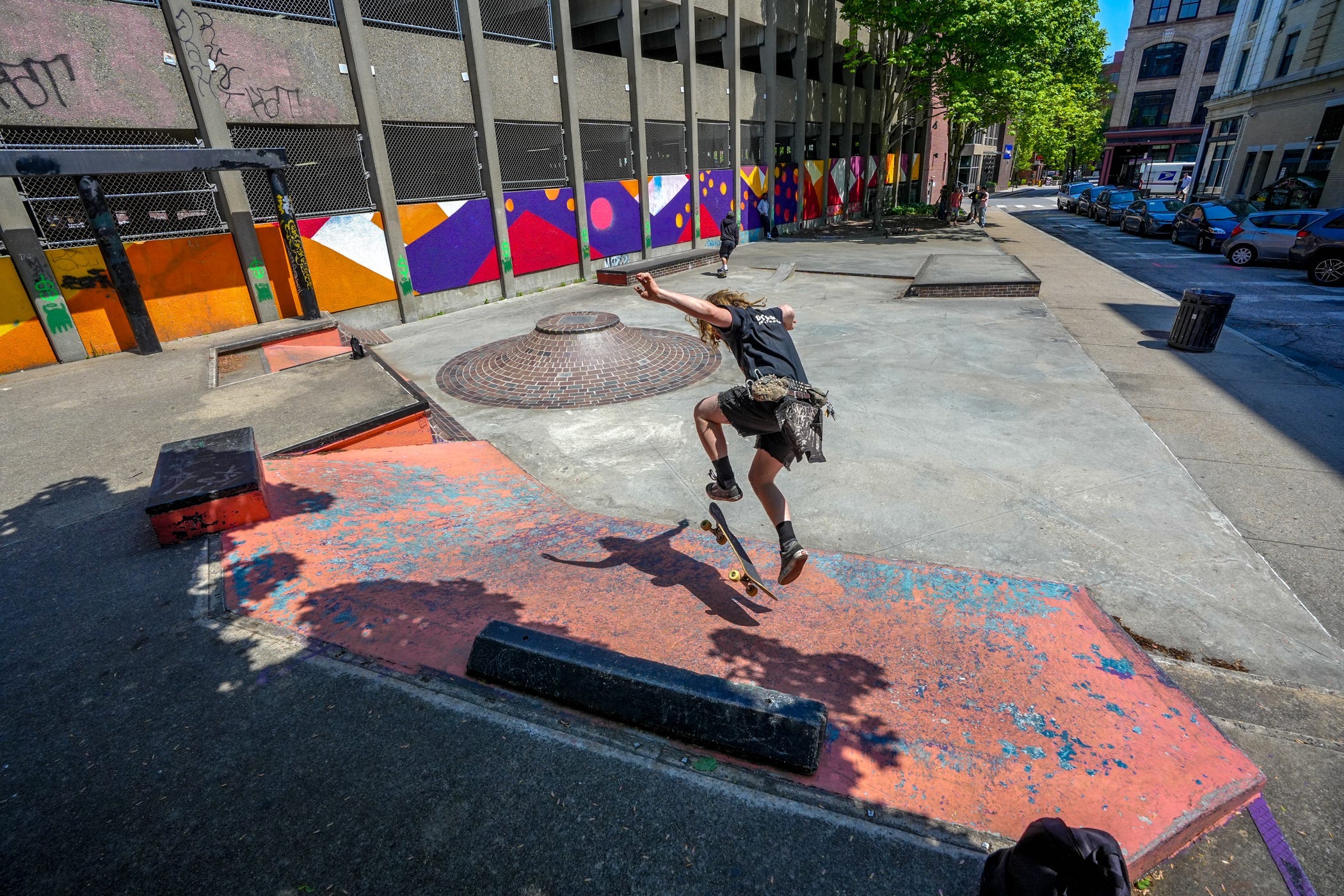
I was in Providence for a conference. One evening, I got a text from a friend. A woman had been following her and saying things that felt threatening. She didn’t know where to go, but she remembered the skatepark. It felt like a place that might still be awake. She headed there.
And she was right. The skaters were still out. They saw what was happening. And without hesitation, they stepped in and got the woman to back off.
This is what we mean when we talk about eyes on the street, but it’s more than that. It’s the idea that safety isn’t about fences or cameras or pushing people away. Safety is about people being present. It’s about the kind of aliveness that happens when a space belongs to someone, even if that someone is just a kid with a scratched-up board and a pocket full of stickers.
Most people are good. And those we think of as not good are often just lonely, or lost, or in pain. But in an imperfect world, we should build spaces that make room for the many versions of ourselves we might become.
Maybe someday that parking garage will be replaced with something better. Maybe the building will open its doors to the street and soften its edges. Maybe the park will serve toddlers and grandmothers and office workers on lunch break.
But I hope, with everything in me, that Providence never gets rid of the skaters.
Play—designing for the future end user
My city did something almost unheard of. It took a polluted, forgettable place and turned it into somewhere people actually wanted to visit.
We restored a bridge across the Tennessee River and made it fully pedestrian. We built a world-class aquarium, and the public square outside of it wasn’t just decorative, it was playable. We tore out a highway that ran along the riverfront. And across the river, where the bridge leads, we built a park that people still envy. It had a splash pad before those were everywhere, wide open greenspace, and a carousel that, as far as I know, still only costs about a dollar to ride.
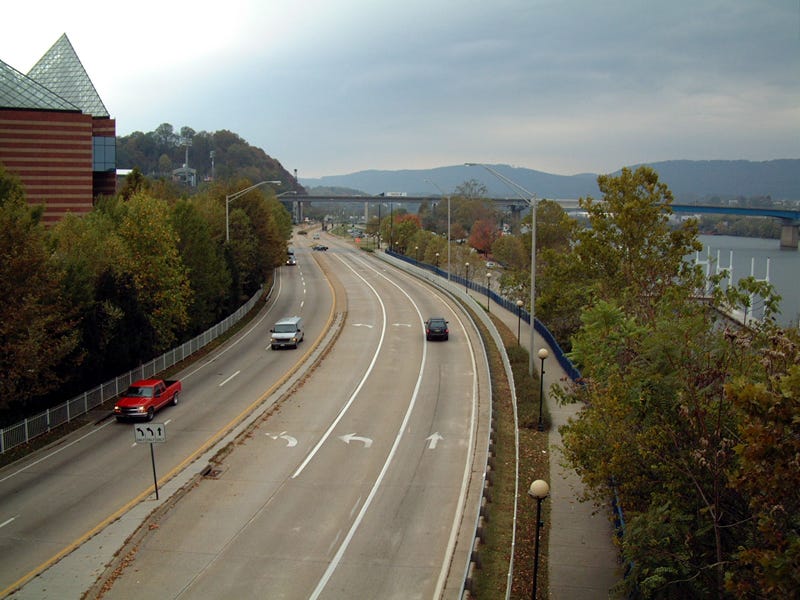
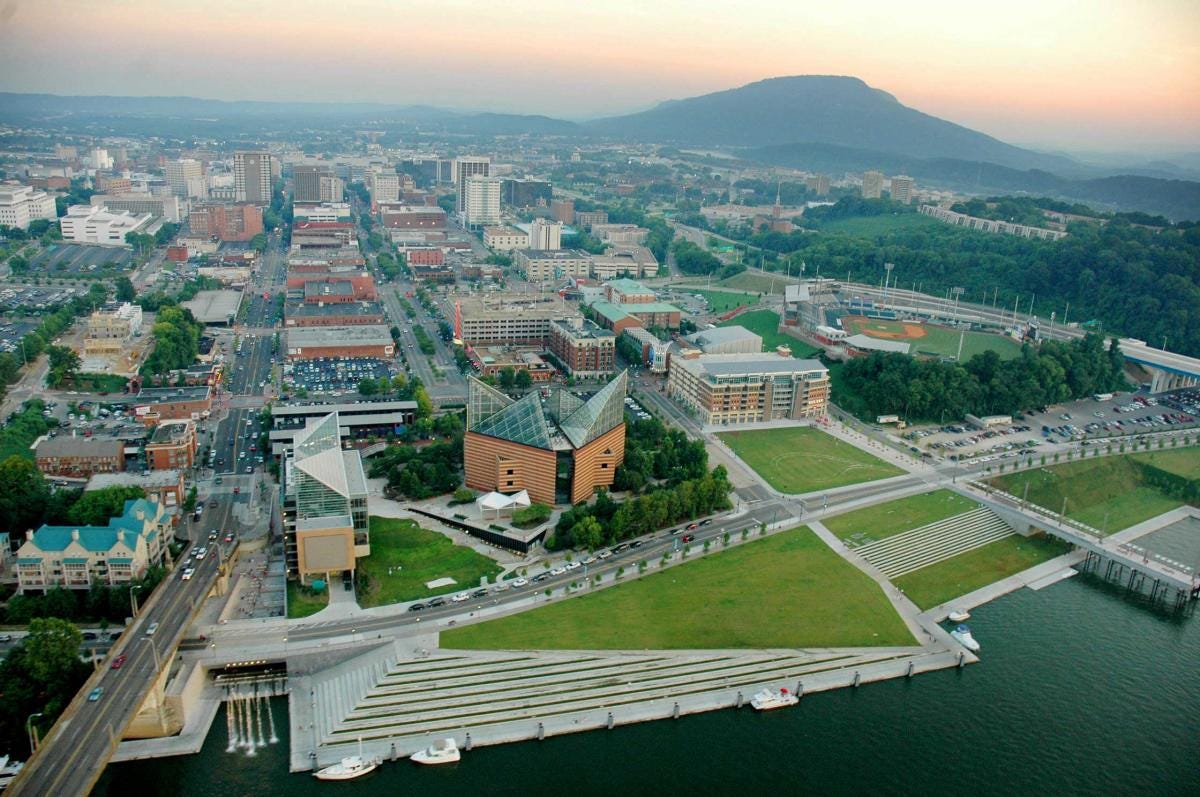
And yet, somehow, we’ve convinced ourselves that the only way forward is to keep repeating that success, just louder. We built a convention center. A baseball stadium. And now, twenty-five years later, we are rebuilding that same stadium.
We added a protected bike lane. Sort of. And then we removed it. Also sort of.
At some point, we have to ask a different question. Not what brings people here for a weekend, but what makes them stay. Not just what entertains visitors, but what sustains residents.
We currently have eight or ten hotels in various stages of construction. But the people staying in those rooms aren’t our city. And while hospitality matters, it also demands constant stimulation. Festivals, concerts, parties. These are good things. But what is the small, local expression of art that lives between the big events?
That’s what surprised me about a video I saw out of Copenhagen.
The whole city seemed designed for interaction. Not for tourists, but for one of the most sought-after signs of a truly healthy place: children.
A city with a healthy number of well-adjusted children is a city where something is going right. If skaters are a kind of pioneer species, showing up first to signal new life, then children are our indicator species. They show us whether the ecosystem is thriving or failing.
Their presence, or absence, tells the story of the city better than any brochure.
Indicator species are organisms whose presence, absence, or abundance reflects the health or characteristics of a particular environment.
In this case, kids are what ecologists would call a positive indicator species. When a place is welcoming to children, it tends to be good for everyone.
Jan Gehl, the Danish urban designer who helped reshape Copenhagen, put it simply: “We must design cities for people, not just cars. And that includes the very young and the very old.”
In Copenhagen, this philosophy shows up everywhere. Play isn’t restricted to fenced-off parks with rubber flooring and signs that say “ages 5 to 12.” Instead, the entire city is meant to be explored. Walls can be climbed, benches can be balanced on, and public art can be touched. The boundaries between play and daily life are intentionally blurred.
Chattanooga likes to call itself a “city in a park.” It’s a nice phrase, and sometimes it even feels true. But Denmark uses a different term: Byen som legeplads — the city as a playground.
It’s not just branding. It’s a design ethic. And as much as we’d love to live up to our own claim, we fall short.
One reason is that the changes required might feel controversial. Turning a wide, underused, four- or five-lane stretch of downtown into a linear park sounds radical. But maybe it shouldn’t be. Maybe it’s just what a city does when it decides that children — and by extension, everyone else — deserve space to move, to play, and to belong.
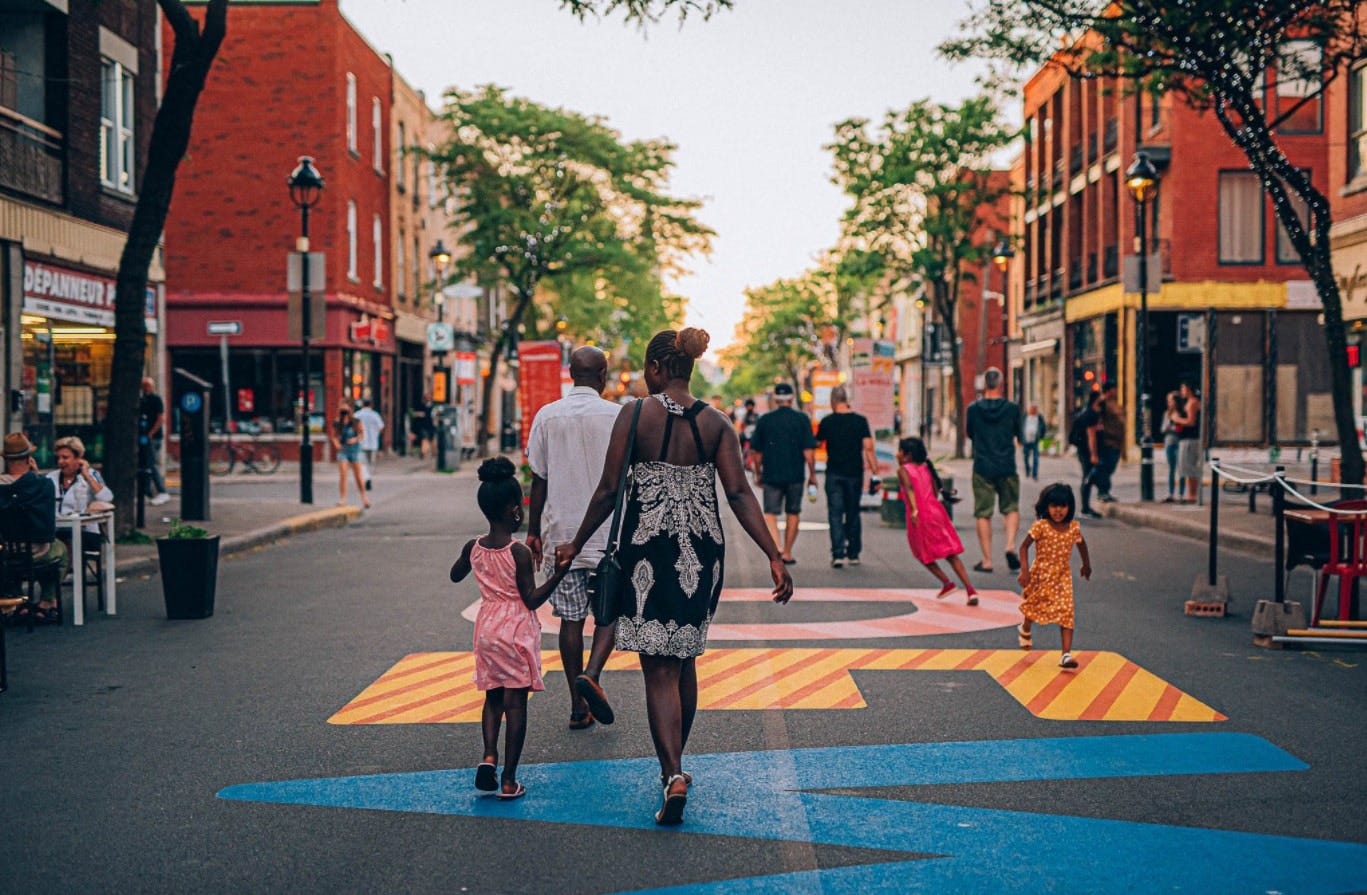
Again, going to Lafayette as an example, they turn Rue Jefferson downtown into a fully pedestrianized space so regularly that they have removable bollards that are stored near the intersections they regularly close. And in Montreal, their Pedestrian Street programs closes off miles of streets to cars over the summer and adds games, art, seating, and paint to invite people into the space. What’s more, Montreal’s Ruelles Vertes, or “green alleys” have greened hundreds of alleyways across the city and turned them into places where kids flourish.
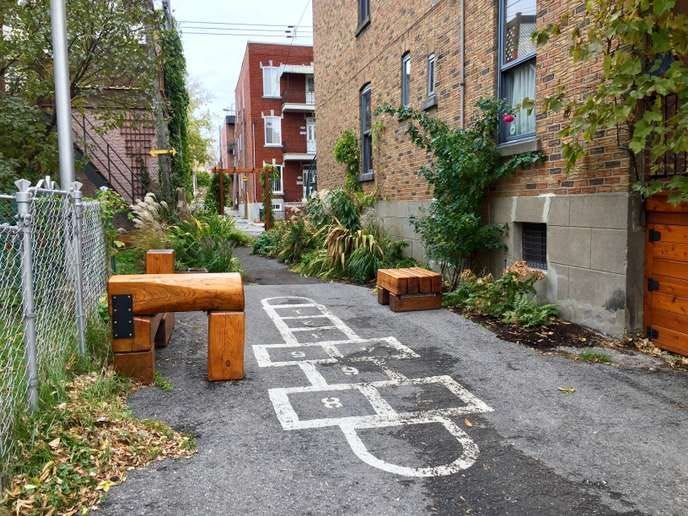
If cars are the most dangerous part of a city—and they are—then maybe, if the city won’t make the streets safer, we need to focus on the places where cars aren’t. The spaces that still belong to us, or could.
In my case, that means the alleys. Especially in the first-ring suburbs and the neighborhoods just beyond downtown, where kids live and should walk and ride bikes. These quiet, overlooked spaces are already halfway there. All they need is imagination. All they need is intention.
The problem with downtown Chattanooga isn’t that it’s boring. It’s that it has beauty, but the beauty is isolated. We built destinations and then separated them with parking lots and fast roads. Thirty-five percent of downtown is parking. Most people don’t actually live there.
We love cities that feel lived in, but our city core doesn’t feel that way. So the businesses that survive are the ones built for people who drop in and leave—tourists and business travelers. Not locals.
It reminds me of this: imagine someone survives a car crash and gets life-saving surgery. They make it through. It’s a miracle. But as they begin to heal, it becomes clear there are other problems—a broken foot, nerve damage, things that need therapy and smaller, slower interventions. And yet the hospital, thrilled by the success of the original operation, just keeps scheduling that same surgery again and again.
That’s Chattanooga. Our life-saving surgery was the big downtown projects—the aquarium, the children’s museum, the IMAX, the stadium, the walking bridge, and Coolidge Park
And honestly, that’s a lot of so-called up-and-coming cities in the U.S.
We made bold bets, and they paid off. But if we keep skipping the next phase—the smaller, quieter work of repair—we’ll never become the city we could be. What got us here is not enough to get us there.
And while I’ll keep advocating for policy and funding and better city planning, I’m not going to wait around for permission. I will do what I can. I will green my alley. I will make my street safer. I will take whatever is in my reach and use it to build a city that works for everyone.
This is what proximal placemaking looks like.
You start with the neglected places. You notice who’s already there—the pioneer species, like skaters—and you make the space just a little more hospitable for them.
Then you ask a bigger question. Who should be here? Who signals health and possibility? That’s where the indicator species come in. That’s where the children show up. And so you begin to shape the space for them too.
No place is ever finished. But you can sense when a place is not becoming.
Cities are not products. They are processes. And it’s the process we need to change.
Streets should be places.
This might be my favorite issue of this newsletter so far. You might find this new research from Brookings Metro of interest: https://www.brookings.edu/articles/small-and-midsized-downtown-recovery-overcoming-obstacles-and-uplifting-innovative-solutions-in-four-regions/
Downtown Cincy is 14% parking. Downtown Richmond is 10% parking.