
Ptolemaic complexity
Sometimes people are incredibly right at being wrong.

It’s hard to overstate the chokehold the geocentric model had on science.
For nearly 1,400 years, people believed (deeply, confidently, and stubbornly) in a universe that turned out to be wrong.
And the reason wasn’t ignorance so much as it was effectiveness: for all its flaws, the model worked.
It explained what people saw in the sky well enough to feel true. It had explanatory power. So as generations experienced reality through that framework, the world kept lining up with the story they were telling about it.
In this issue, I want to explore how that happened, how change finally broke through, and why the story matters today. Because the way we once misunderstood the universe has more in common with the way we design our cities than we might like to admit.
Along the way, I’ll point to real-world examples that make this parallel impossible to ignore.
Explanatory Power
Ptolemy’s model was built to solve a simple but stubborn problem; the planets did not move through the sky in smooth, predictable paths. Sometimes they slowed down, sped up, and they even appeared to move backward.
Claudius Ptolemy gave people a way to make sense of this strange motion, turning messy observations into something orderly and understandable based on geocentricism: stuff revolves around the earth. And this was not an idea he invented, but inherited; everyone assumed this.
After all, it matched what people saw. The sky seemed to spin and the ground felt still. When the world appears to move around you, it feels reasonable to assume that you are standing at the center.
But reality did not always match this assumption. And Instead of questioning it, Ptolemy added a solution; Epicycles. Small circular motions layered onto planetary orbits to explain why planets sometimes appeared to move backward in the sky.
Despite its flaws, the model worked well enough to be useful. It could predict where planets would appear, helping sailors navigate, farmers plan their seasons, and astronomers make sense of the sky.
It even helped forecast eclipses and guided the creation of star charts. The explanation may have been wrong, but the observations were right, and for a long time, that was enough.
Still, different things kept breaking in the model. Planet brightness, for one, was not neatly explained. And every time something like this happened, more epicycles were introduced. And the system grew ever more complex.
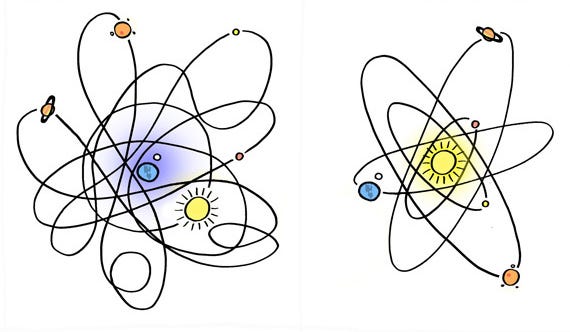
The Ptolemaic system did not fail all at once. It slowly frayed as better observations exposed small but stubborn inconsistencies. In the 1500s, Copernicus suggested something radical; What if the Earth itself was moving.
The idea was treated with caution and some saw it as mathematically useful but physically wrong, while others dismissed it as philosophical speculation.
Then Galileo pointed a telescope at the sky and he saw moons orbiting Jupiter as well as the phases of Venus. Either there was going to be an infinite amount of epicycles-like explanations to add, or reality had to be faced. These discoveries challenged more than calculations as well as the story behind them.
The universe was no longer revolving around us.
Ptolemaic patterns
This pattern shows up in all kinds of places. Think of it as a Ptolemaic pattern. A widely accepted theory that grows more complicated in order to protect its core assumptions. Bloodletting was once accepted as medicine, and when it failed, the techniques became more varied and more elaborate.
Almost every fad diet, workout untested plan, or money making scheme follows the same arc.
👉 A simple assumption.
👉 A system that mostly works.
👉 More complexity to fix its flaws.
👉 Then a breaking point.
And now it is time to apply this to cities.
Cars! Cars! Cars!
There is a common assumption that America looks the way it does because it was shaped by the automobile, and that our cities sprawled simply because we had the space to do so, unlike Europe.
This is untrue on multiple fronts.
More importantly, as someone else once put it more elegantly, America was not designed for the car. It was destroyed for it.
Our cities once resembled, and in some places still resemble, their European counterparts, because that is how cities naturally make sense. Useful things placed near the places where people live.
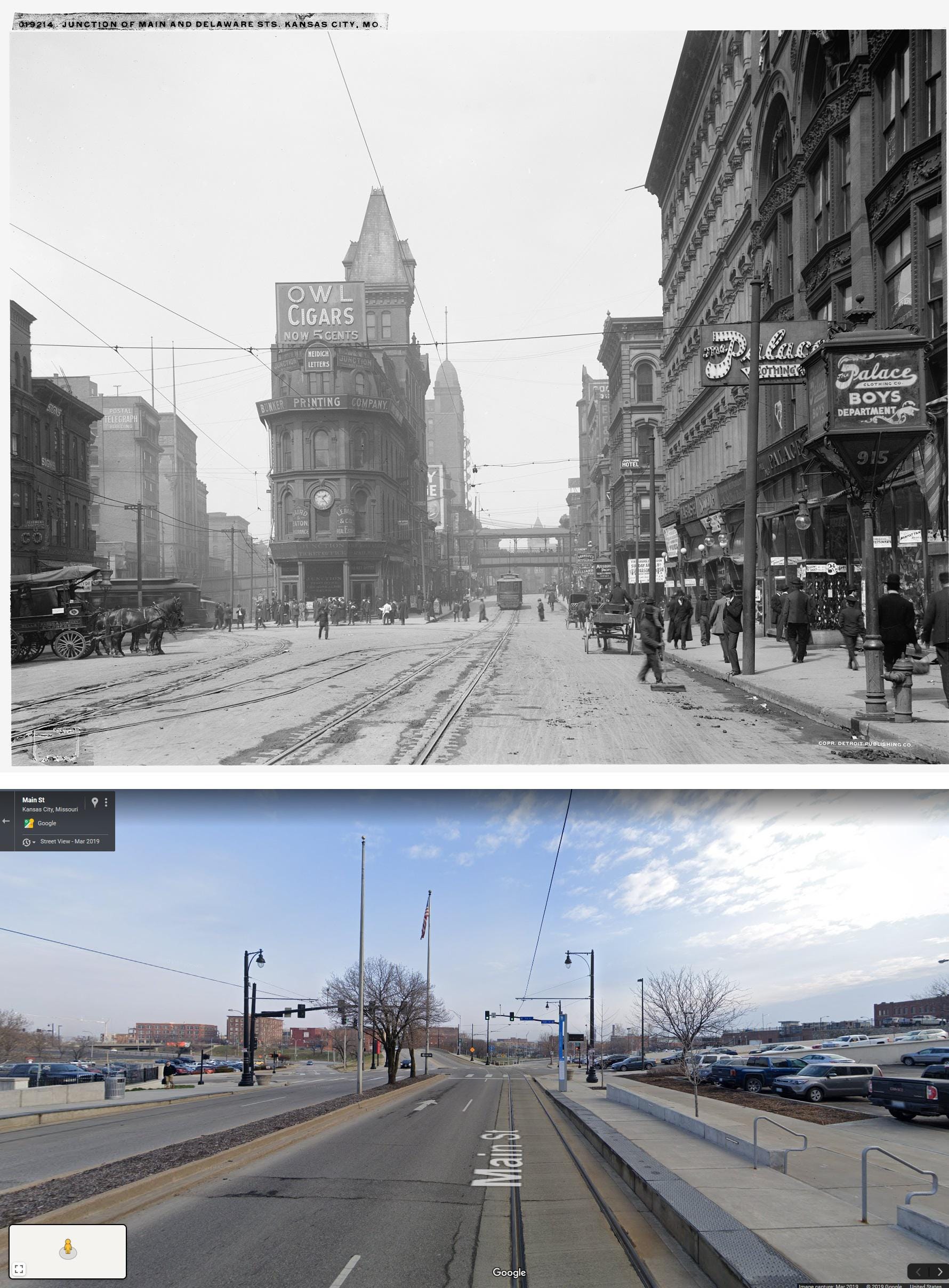
But this destruction did not happen all at once. Like most new technologies, the car was met with resistance and suspicion. Before automobiles, streets looked more like public squares. People walked, lingered, and nothing moved faster than a horse.
Then the cars arrived, and people began to die.
In the 1920s, even with far fewer vehicles on the road, traffic deaths per person were higher than they are today. Pedestrians, especially children, were among the most common victims.
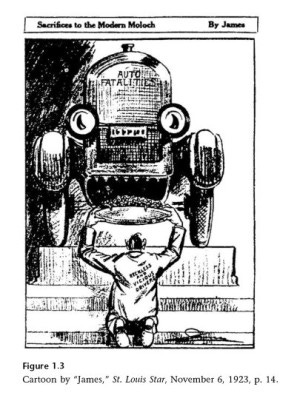
And people noticed. Grief often turned into anger. It was not unusual for police to needing to protect drivers from mobs after a child was killed. Newspapers ran cartoons comparing the automobile to Moloch, the ancient god said to demand the sacrifice of children.
The danger was not theoretical. It was right there in the street.
The epicycles needed to justify the car
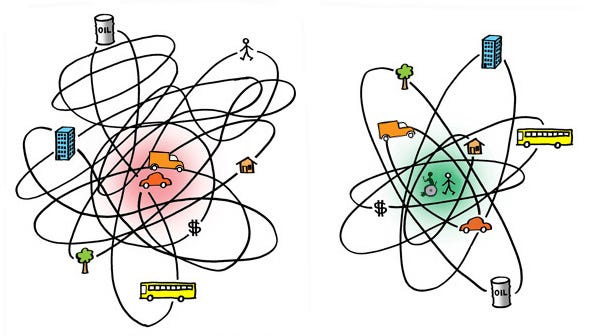
Eventually, the car became the center of our vision of progress. And as that vision began to fracture, we added layer after layer of explanation to keep it standing. Below are three ‘epicycles’ or changes we needed to make to coninue to keep the car at the center.
1. Epicycles of Space
Cars do not just move through cities. They settle into them. They demand storage in the most valuable places we have, and then they wait there, quietly, for most of their lives. To accommodate this stillness, we built a second city on top of the first one. A shadow city of lots, decks, setbacks, and curb cuts, where empty space is treated as a civic achievement.
For decades, zoning codes required new buildings to provide parking, without evidence and always in excess. The result is a country with roughly eight parking spaces for every car. In many cities, parking consumes close to a third of the land area. Restaurants are required to build lots larger than their dining rooms. Downtown blocks disappear under concrete decks. We have, in some places, built more housing for vehicles than for people.
These rules were meant to solve a problem. Instead, they reshaped the city. Businesses spread farther apart. Walking became less practical. Every trip grew longer. And as driving became easier, demand increased, which made the “parking problem” feel permanent.
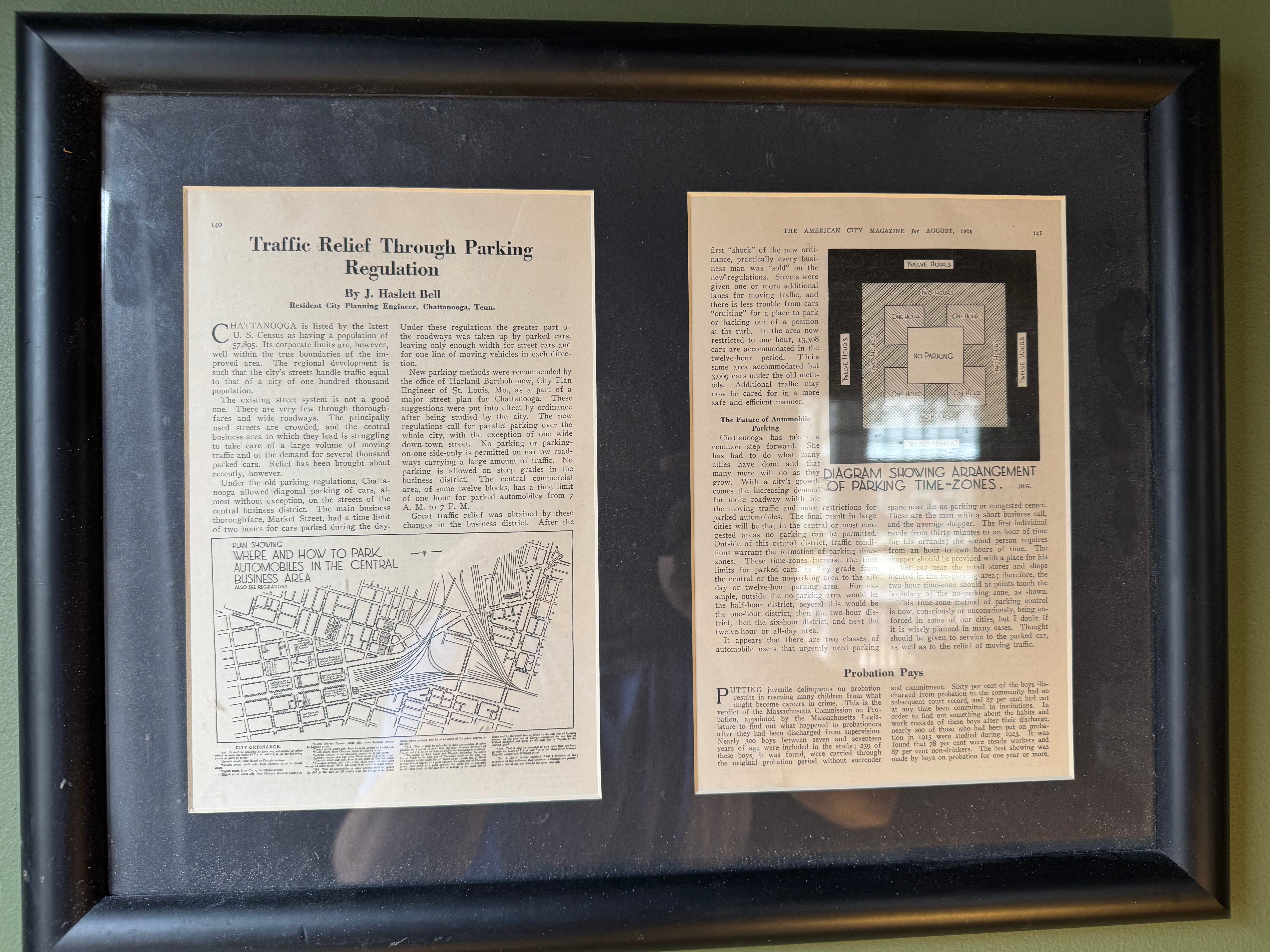
In Chattanooga, this pattern reads like a long-running series. Articles from the 1920s and 30s promised solutions to the parking problem, and the same promise still appears today, sometimes framed as convenience, sometimes as downtown revitalization. Our current mayor even made downtown parking a pillar of his reelection campaign.
2. Epicycles of Flow
Once a city is built around cars, movement becomes a moral obligation. Traffic must keep flowing, even when there are too many vehicles, even when the place they are moving through is dense, historic, or human.
So we build around the problem.
We widen highways.
We add lanes.
We stack ramps into concrete spirals.
In Los Angeles, the five-level Pregerson Interchange stretches a mile and a half, with nine miles of looping ramps, a maze of soaring concrete that cost $135 million to construct. In Milwaukee, the Marquette Interchange required 28 ramps and 21 miles of roadway, along with $810 million in public investment. These structures are engineering marvels. They are also monuments to how difficult it is to preserve high-speed driving in the middle of a city.
And when congestion returns, as it reliably does, we reach for the same solution. Houston widened the Katy Freeway to 26 lanes at a cost of $2.8 billion. A few years later, travel times were worse than before. More lanes invited more cars. The system worked exactly as designed.
Each expansion is meant to fix a problem without questioning the premise. The car must remain central. The city must adapt. So the roads grow wider, the interchanges taller, and the distances longer. The complexity is not accidental. It is the price of protecting the original assumption.
3. Epicycles of Safety and Control
When you move heavy machines quickly through places where people live, the city has to become a constant apology. We add signals and signs, crosswalk buttons that ask permission, guardrails to contain predictable mistakes, and pedestrian bridges that quietly admit the street is no longer a shared place. We add enforcement where design fails, and then more enforcement to manage the enforcement.
And still, the harm continues.
In the United States, roughly 40,000 people are killed in traffic crashes each year. That is the equivalent of a 9/11 every month, or a plane falling from the sky every few days. Millions more are injured. Car crashes remain one of the leading causes of death for children and young adults. This is not an accident. It is the natural result of moving fast, heavy machines near fragile human bodies.
In the early days of the automobile, this violence felt optional. People were angry in a way we struggle to imagine now. In the Netherlands, parents organized under the slogan Stop de Kindermoord, Stop the Child Murder, after more than 400 children were killed by cars in a single year. Instead of adding more rules, they redesigned their streets. By prioritizing people over speed, they cut traffic deaths dramatically. Today, their fatality rate is about 60 percent lower than the United States.
We, meanwhile, chose a different path. We layered our streets with seat belts, airbags, speed limits, fines, and laws. These epicycles of safety help. But they never solve the core problem. A system built around cars will always require damage control.
But there is a new way
America was not the only place reshaped for the car. European cities were too. Even in the world’s most pedestrian friendly places, cars still claim large stretches of street. Every protected bike lane is a type of admission that the nearby road is not safe to share. And where streets are shared, parking can fill the edges or disappear underground into garages that can cost tens of thousands of dollars per space.
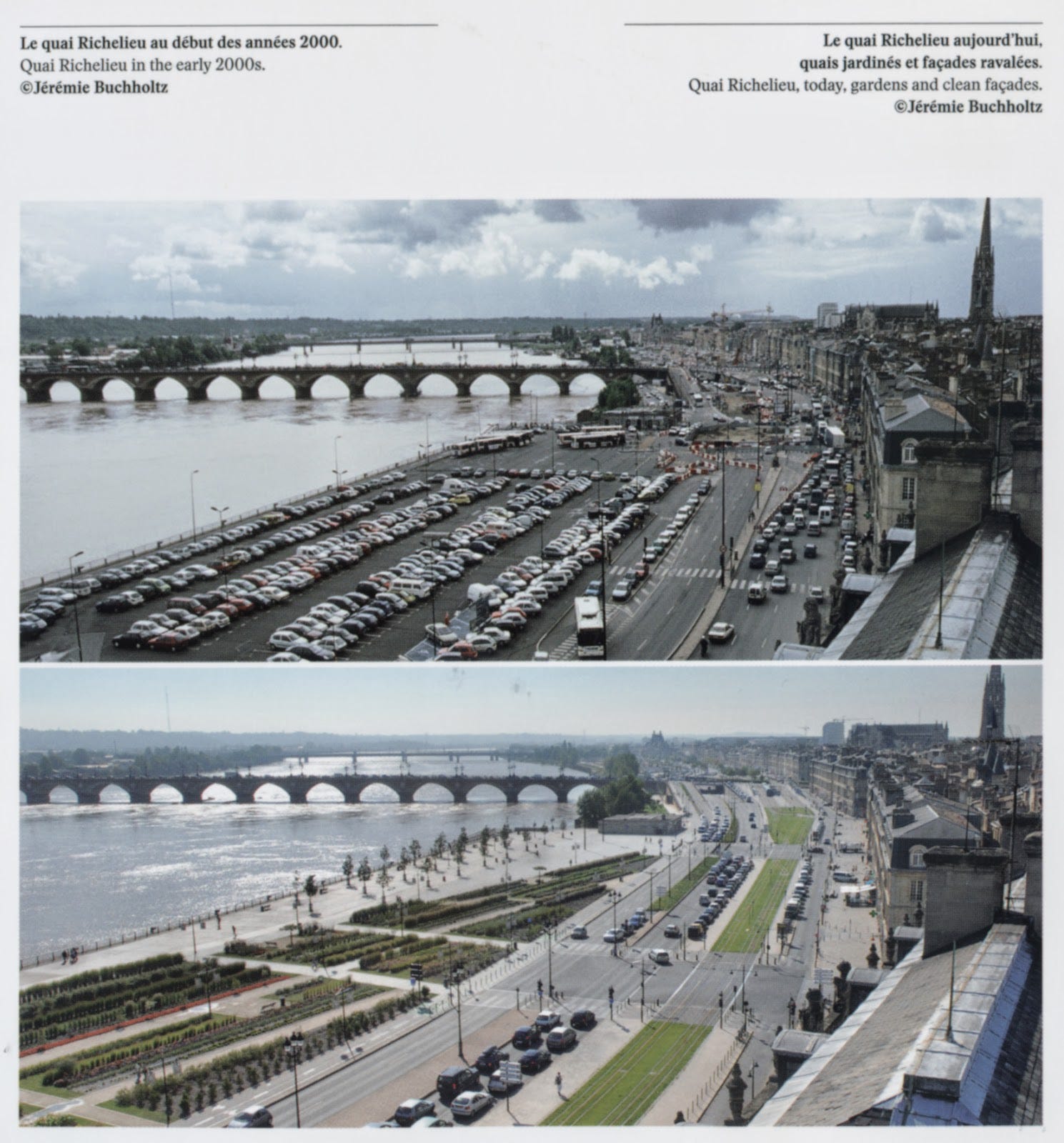
The rest of the world made many of the same mistakes. They are also quicker to undo them. I remember standing in Bordeaux, stunned to learn that its beautiful riverside promenade used to be a parking lot.
And that is where the hope begins.
3 examples of hope:
When you begin to decenter the car, you meet resistance from every direction. People with disabilities raise concerns about accessibility. Left leaning progressives talk about the privilege of removing free parking. Others point out, correctly, how deeply even low income households rely on cars. An attack on the status quo will feel like an attack on everyone, so expect resistance from everyone.
Do you want to support my work?
Consider becoming a paid subscriber. You won’t get anything extra, my Substack will always have a fully free option. But your support helps me make the time to pursue and share ideas like this one.
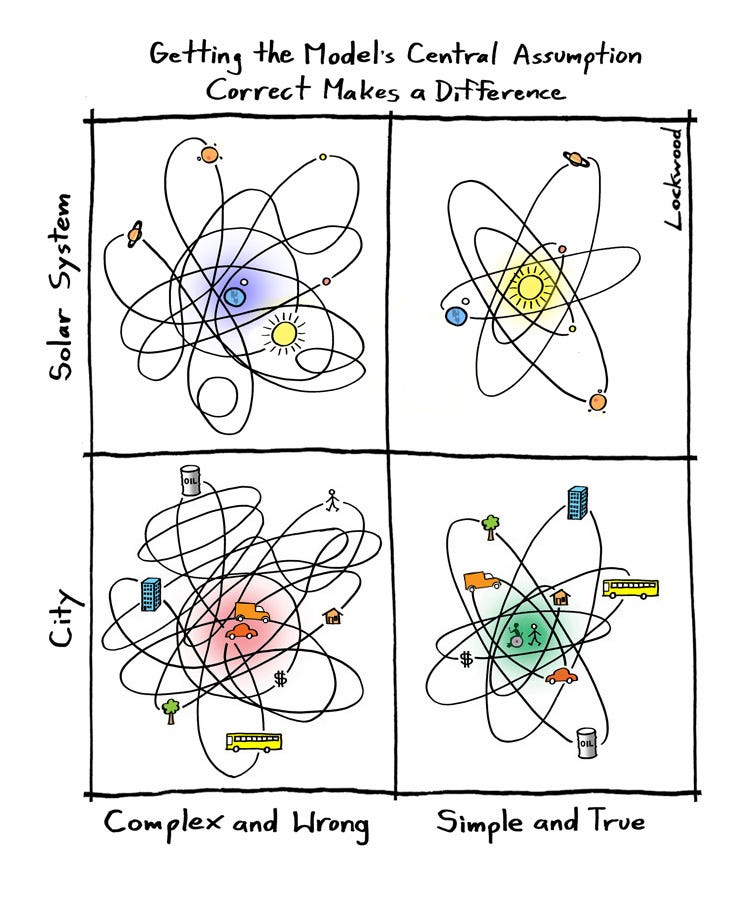
But this is where Ian Lockwood’s full illustration becomes so important. Changing the center of a system is not a small adjustment. It is a fundamental shift that challenges our assumptions about how the world is supposed to work. And yet, in the long run, it often makes life simpler for everyone.
Below are a few examples of cities that put people back at the center, and what happened when they did.
1. Pontevedra, Spain
Pontevedra didn’t “manage” traffic so much as it stopped feeding it. Starting in 1999, the city pedestrianized large parts of its center, pulled out on street parking, and made driving through downtown feel less like a right and more like a choice with consequences. The results were blunt in the way you want results to be: on streets that saw 30 traffic deaths from 1996–2006, there were three in the next ten years, and the city reported CO₂ emissions down 70%.
2. Seoul, South Korea
Seoul took an elevated highway and turned it into a stream again. The Cheonggyecheon restoration created a corridor through the center of the city and delivered measurable changes: one case study reports an average 3.6°C cooling effect in the surrounding area. The point is not that every city needs a stream, but that a city can remove car infrastructure and end up with something simpler, cooler, and more alive than what was there before.
3. San Francisco, USA
After the 1989 Loma Prieta earthquake damaged the Embarcadero Freeway, San Francisco faced a choice. Rebuild a double deck highway along the waterfront, or remove it and try something different. The city chose removal. What many feared would cause permanent gridlock did not. Traffic redistributed. Transit use increased. And more than 100 acres of formerly dead space under the freeway became parks, plazas, and developable land. Housing in the area grew by 51 percent, jobs by 23 percent, and the waterfront became a place people actually wanted to be.
Gentle stewards of change
I hope you begin to notice Ptolemaic patterns everywhere. Ideas that once served a purpose, but grew so complicated they began to reveal the need for a better foundation. The world can often be made both simpler and kinder by choosing what works for the many, not just the few.
And I hope, as you see this, that you are gentle with people. Change asks something of them. You must win them over, engage their imaginations, and sit with them in their grief when they experience the loss that comes with change. This work is not easy, but it is necessary. It is not enough to be angry. We must change hearts and minds with care, yet with the urgency as if peoples lives depend on it, because they do.
Sources that might interest you:
Great site for seeing how cars disrupted cities
Maps of cities across the US and the amount of space dedicated to parking
Urban 3 and Strong Towns illustrating how the ‘epicycle of flow’ disrupts local land values.
Video on Pontevedra Spain, and a NYT article if you have a subscription.
Article on Seoul returning the stream
How my city removed a highway and the sky didn’t fall, but a riverfront was reopened to humans.
A video of San Francisco in 1905 and showing how streets moved slowly and were more like a public square than a thoroughfare.
I currently live in Denver, CO and before that, Fort Collins, CO. Both cities have a lot of work to do concerning making their streets more inviting and safer for pedestrians. In 2024 I was managing student housing and experienced the death of two of my residents within the same year. These were both college students simply walking to class…
The conversations I had with the parents of those students changed me forever, and I am inspired and reassured by your message and hope our community leaders hear it too!
Thank you so much for your perspective! You make me want to build wonderful things in my community 💚