
The Long View
(things are bad)

Of Rapture and Revolution
In almost every political or religious movement, there is a group that finds a way out — a version of the philosophy that lets them stand on the sidelines while still feeling like they are part of the cause.
In Marxism, it’s the revolution. Many believe capitalism can’t be defeated until it collapses on its own, so they wait for its demise rather than working toward change now. Any solution is marked as doomed to fail because we live in a capitalistic society, or it fails some purity test and is deemed capitalistic itself.
In Christianity, it’s the rapture. Since Jesus is expected to return only when the world is in ruins, every disaster can be framed as a step toward a promised ending.
But the Revolutionary and the Christian both become my friends when they share this commonality: they are helping people right now. They are not testing the purity of someone’s beliefs, or dismissing their work because it doesn’t match an exact philosophy. They are not waiting for a second coming.
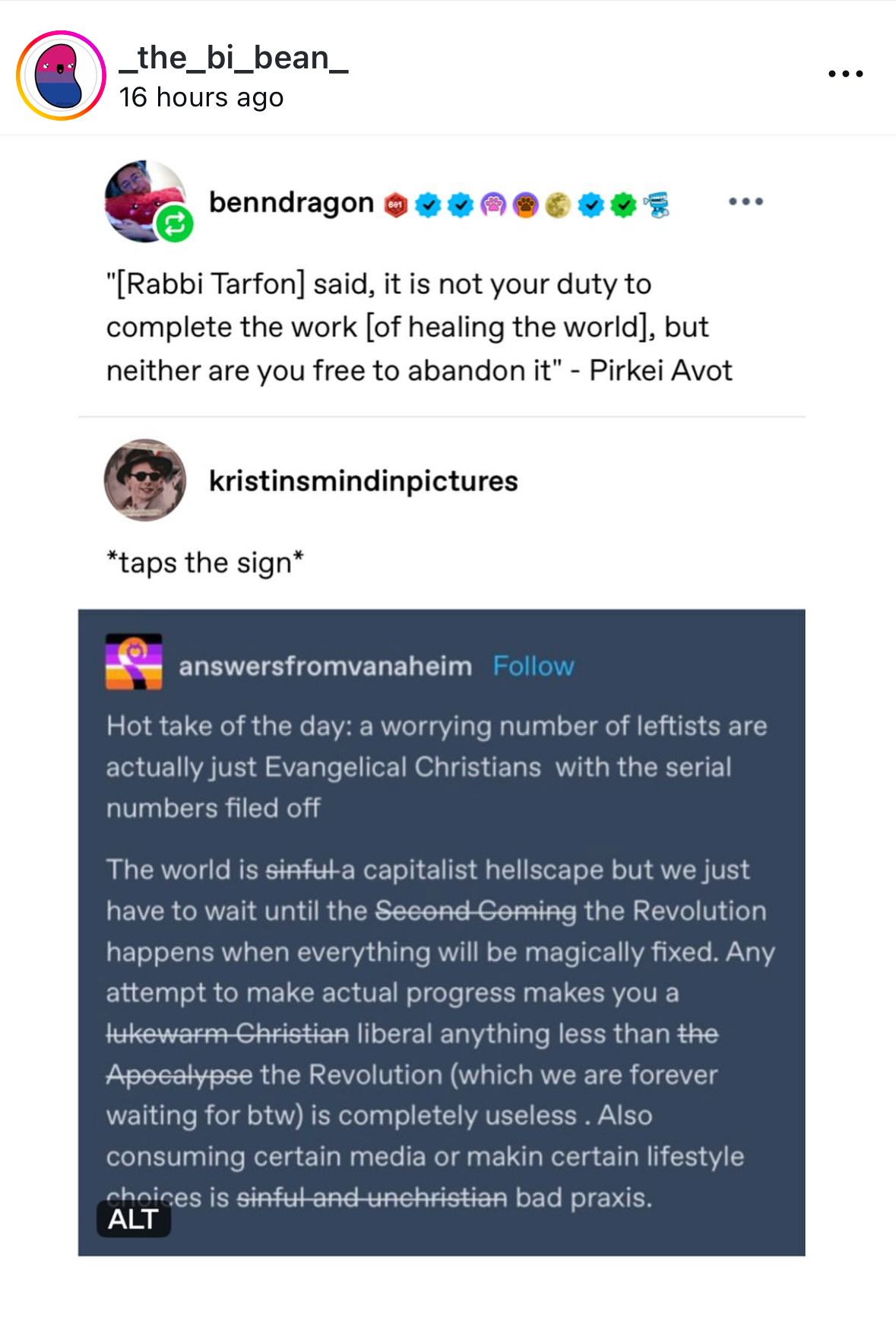
This is not a critique of Christianity or Marxism. It is a critique of the tendency to embrace helplessness and suffering by clinging to a narrative that feels neat and complete, a story that frees you from responsibility.
These metanarratives soothe the mind of someone who has realized they cannot do everything. But in doing so, they strip away responsibility, and then humanity.
A metanarrative is an overarching story or framework that shapes how people interpret events, values, and truth. It functions as the big-picture explanation of reality that guides a society’s worldview, giving meaning and order to individual stories within it.
First comes the thought: I cannot bring about utopia.
Then comes the lie: I cannot make a difference at all.
Change is never permanent, and it is never enough. We crave things like revolution because they promise just the right amount of change in just the right amount of time. If the change is big enough, maybe we can finally relax. We imagine a kind of stasis of goodness, a place where the work is finished and we can simply rest.
But progress is not about arrival. It is never finished, and that is not a flaw. There are meant to be moments of pride, rest, and enjoyment. Yet there is also a quiet advantage in the work being continuous
Confession
Lately, I have noticed so many steps backwards in local government. And I am not alone. The people who are most attuned to progress, the ones who actually help bring it about, feel the same exhaustion and frustration.
Small victories that took years to win seem to be slipping away. The good civil servants, the ones who cared more about mission than a salary alone, are leaving faster than ever, moving to the private sector because their work was never sustainable or fulfilling enough to keep them. There are many great people still here, but I’m not sure for how long. One friend did a compilation of turnover within the local government and found that, while recent administration saw ~1,000 jobs turnover in a term, the current administration saw ~1,600.
Realizing this backslide can either be a call to action or a punch to the gut. For me, it is the punch. I’ve spent time digging deep and had a small amount of time to myself and realized four things:
Infinite game—it’s never over
It helps to know the change we seek is not only beyond our efforts, it is beyond our comprehension. In our lifetime, we accomplish only a fraction of what can and should be done.
One way to think of this is thinking in types of games. There are two types of games that make up all of reality: finite and infinite (Re: James Carse explained this in Finite and Infinite Games). A finite game is what we usually mean when we say “game.” It has a set duration, clear rules, winners, and losers. Pickleball, poker, chess—all finite.
But infinite games are different. They have no end, and the goal is not victory or defeat. The goal is to keep playing. Friendship is an infinite game. You are not trying to win. You are trying to sustain it.
The problem comes when we use finite thinking for infinite processes. A business that declares it has “won” is already beginning its decline. That is why competition matters. Without a worthy rival, the game ends. Monopolies are death throes for an infinite game. And that is why it feels hollow when a boss says “crush the competition.” You know deep down that this is a game not meant to be won.
Simon Sinek used baseball to explain this. Imagine if baseball were an infinite game. The purpose would not be the score. The purpose would be to keep playing. Endurance would matter more than RBIs. Collaboration would matter more than no-hitters.
“The Revolution is in the individual spirit, or it is nowhere. It is for all, or it is nothing. If it is seen as having any end, it will never truly begin.”
-Ursula K. Le Guin
A city is an infinite game. The first goal is to keep it going. Community is infinite. And when you are discouraged, it helps to take the long view. No library is ever complete. There is no single book that ends the need for more books. Our work is the same. It is a stream that existed before us and will continue after us.
I recently saw a video about a family reunion in Mississippi where more than 500 people come together, all descended from a single family. Over a thousand descendants trace their roots back there, and the celebration has taken place on the same property for more than a century.
This preservation of culture, of family, of shared history, is an infinite game. No one is looking for a reason to stop hosting it, the point is to keep it going.
This is what I meant earlier about the quiet advantage of the work never being done. Just as the hard part is never finished, neither is the joy. It is an endless well, not only of challenges but of meaning. You will always be needed. You will always belong, because there will always be a role for you—one that will never be finished.
We may water seeds we did not plant, and we may never see them bloom. We may harvest what others tended, and plant what others will care for. There is relief in knowing it is not all up to us. If we keep the work going, we have done our part.
Embracing the dips—it’s never linear
From far away, upward mobility looks simple. A neat arrow, clean and confident, pointing up and to the right. But when you are inside it, the line is jagged. Some days you climb. Some days you tumble.
And yet, if you zoom out, the shape is still there. The gains survive the losses. Each peak rises a little higher than the last. The floor you fall to is higher than the one before.
This is how progress works. It is not a straight line. It is a messy staircase, a corkscrew to the summit, a tide that rises in waves. The dips are not detours from the pattern. They are part of the pattern.
If the work is an infinite game, there is a quiet comfort in knowing that even when you are in the valley, you are still part of the climb.
Right now, I feel like the city is in a dip, not on a rising line. But even here there is a strange kind of encouragement. The highest points often follow the deepest troughs, because both are born of the same energy. Resilience grows in the dips. The skills that keep you moving upward are usually forged when everything feels lowest.
It’s not you, it’s us
We love Batman partly because we imagine being him, and partly because we imagine the relief of not having to be him. He carries the whole burden so we do not have to.
Even in the most powerful claim of a single individual in all of history, Jesus taking on the weight of all humanity, the story does not end with one person doing all the work. It moves outward into a community, into shared responsibility. If the work of someone claiming to be God requires disciples and community, we can’t expect for a singular hero to do everything.
That is another quiet strength of this idea. You are not asked to do it all, but you are absolutely asked to do something. We crave binaries because they are easy. They let us find what suits us and choose a side. But real community does not live in binaries. It lives in spectrums.
In community, we often take on roles that feel like paradoxes. We are asked to love people not because they are lovable, but because they are our neighbors, and therefore worthy of love. Even when they hate us. We are asked to show up not only for the causes we like, but for the people who make us uncomfortable.
Community is where we find ourselves. It is where we take on responsibility and action, but also where we find relief in knowing that others are doing the same. The burden is lighter because it is shared. The work is sustainable because it is not solitary. And the victories are sweeter because they belong to all of us.
It’s not the talkers
So much of online discourse is about being right. We assume that if we are correct, goodness will follow. As long as our facts are in order, we think we do not have to be anything else.
But it is not enough to be correct. You also have to be good. A good neighbor. A helpful neighbor. A good friend is often a fun one, but we do not choose friends because they are right. We do not love our family because they hold the perfect opinions.
Being part of something bigger than yourself asks for more. It asks you to do something about the problems you see.
I talk a lot online. This very writing is talking. But what feeds me is not people nodding in agreement or liking my posts. What feeds me is people showing up.
It is easy to have an opinion. It is harder to be correct. It is harder still to act on correct beliefs. My friend Mitchell says he likes people doing cool shit. And by his life and logic, cool is another word for good.
Find me someone rough around the edges, loud, even obnoxious, who still serves the people who need them, and I will take their company over the most polished, orthodox progressive who claims to believe all the right things but does nothing.
This week, our city flooded. The opinions came quickly — what caused it, who is to blame, what should or should not be done. But you know what made the front page of the New York Times? The stories of people helping. Smashing windows to rescue strangers. Carrying neighbors to safety.
The loudest voices in a neighborhood are often the ones with the strongest opinions. But when the water rises, the loudest thing is not the noise. It is the sound of people showing up for each other.
So how do we get stuff done? A slower even steadier Tortoise.
I once saw a video of a comedian wondering what would happen if the tortoise in Aesop’s fable had to race a slower, steadier tortoise. Who would win then?
That made me think of Quintus Fabius Maximus Verrucosus. His name is a bit of a mouthful, so people called him Cunctator, which means “the delayer.” He was a Roman general who, when faced with an extraordinary commander in Hannibal, refused to fight on his opponent’s terms. He avoided direct battle when the odds were against him, instead cutting off supply lines, harassing from a distance, and choosing small skirmishes on favorable ground. It was slow, frustrating work, but it kept his army alive. Historians see him as an originator of guerrilla tactics.
This is the power that comes when you embrace time as your ally—when you see yourself as part of a continuation, neither the beginning nor the end. You are a single chapter in a story that started before you and will keep going long after you. And if you can accept that, the work becomes less about urgency and more about faithfulness.
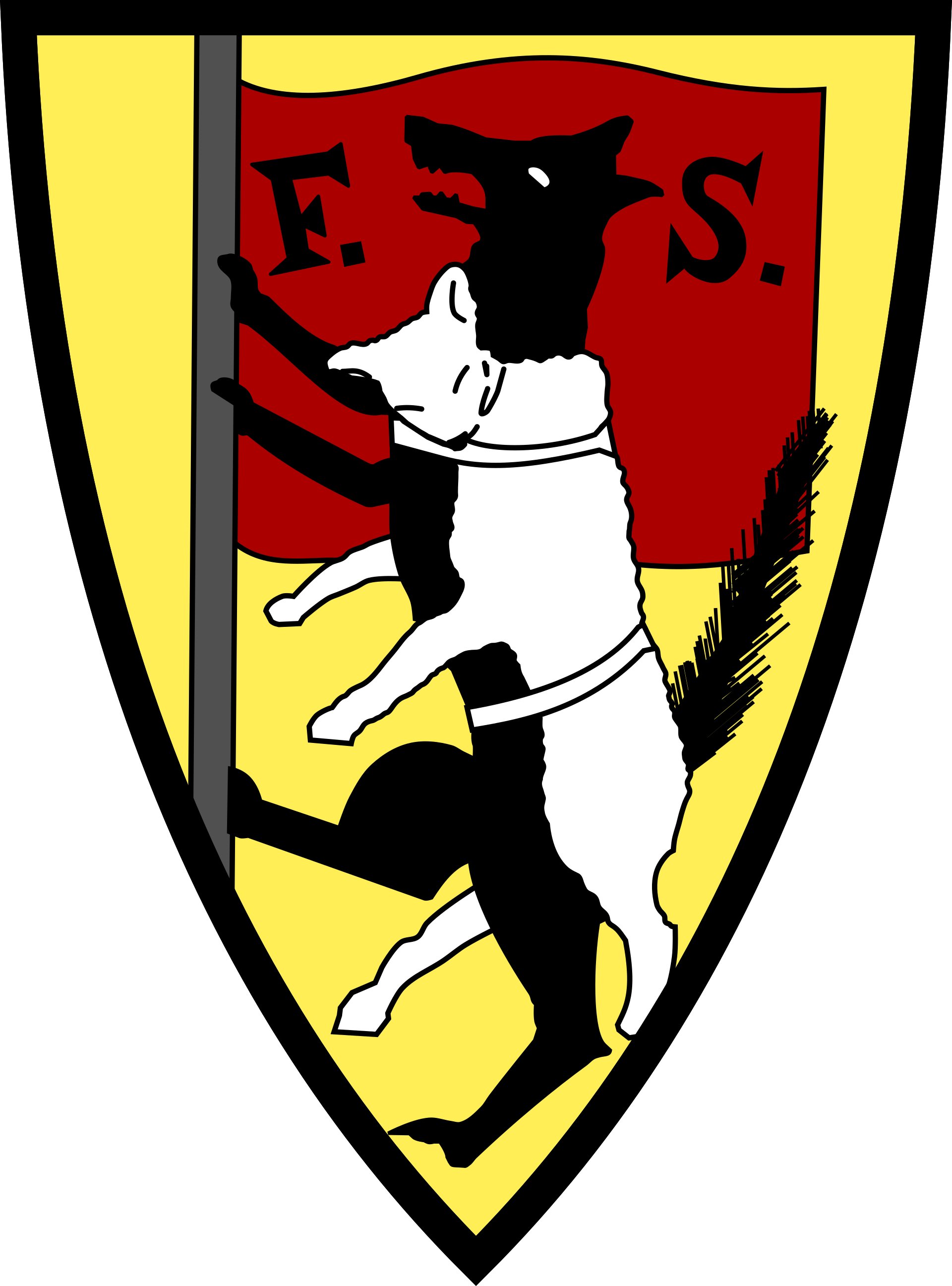
Fabius was so good at this that his name became an adjective. The Fabian Society, a socialist group in British politics, took that name to describe their belief in slow, steady social change over sudden revolution. They worked through incremental reform, cultural shifts, and patient persuasion. Their first emblem was a wolf in sheep’s clothing, a nod to changing the system from within. Later, they chose a tortoise, a symbol of progress that is deliberate, unhurried, and unstoppable. If you like the National Health Service, you might want to thank Clement Attlee, the prime minister who created it, and who also happened to be a Fabian.
I bring all of this up to say that the work is neither at its beginning nor anywhere near its end. It is infinite. You are not obligated to finish it, but you are obligated to take part. Progress is not a race we win. It is a game we keep alive.
Fabius actually was using tactics that the Romans had learned from the Samnites during the wars where they were conquered. One of the criticisms of Fabius was he fought like a Samnite, who pre Carthage were the boogeyman of Rome hardy mountain warriors that they were.
But this plays well into the post, as there is always an after, there was always a before to learn from.
In our case cities once functioned well or at least made more sense but as to why is its own post.
@futureurbanistclub on IG for People~First urbanism from a human who knows the before to a depth few others will ever spend the time too
My sister brought us back a painting of the Notre Dame cathedral, and we drove it across the country with us when we moved.
The cathedral took over a century to complete, so no one who worked on the project at its start would have been alive when the cathedral was finished.
I try to remember that life may call us to unsatisfying work. Like you’re talking about the infinite game; we won’t get the ego boost of a clean and clear victory, followed by rest and a state of perpetual non-conflict.
We seem to be the elemental plane of inciting incidents; anywhere you turn, a new unexpected turn of events that keeps knocking humans out of our complacency; things are never neatly done, we just apply ourselves and mend what we can, and one day the timer will run out on our individual lives, but multi-century cathedrals still get built, and then they’re maintained long enough for a street painter so sell my sister a souvenir to bring home to us. The things we do may not seem to matter much, like Gandhi said, but it may be very important that we do them.